Clearing IEDs and preventing terrorist bombings is an area of great technical importance to the military and the world's governments. Air support remains one of the most effective tools for ground troops clearing IEDs in Afghanistan. The country does not have a flat terrain, and the ground force's field of vision is cut off beyond the hills, where an enemy could be waiting to strike from. Air support also gives troops the ability to "see" ahead, and clear the way before having visuals on the road beyond. What the Pentagon Channel's video above implies, however, is a third, powerful advantage in enhanced communication with civilians in war zones.
The situation being filmed in this video illustrates how air support can determine the difference between daily life (i.e. farming) and planting roadside explosives. A task force is called to clear a road of suspected IEDs, and multiple truckloads of specialists and a helicopter are deployed. This massive force travels down a small, dusty road in Afghanistan only to find that civilians are digging holes for agricultural purposes. They are able to determine their intentions because of the helicopter flying overhead, which is able to relay this information without the ground forces having to travel ahead and risk an unnecessary confrontation. Bringing a powerful force into a civilian situation can create feelings of mistrust in the local communities, and US forces rely on strong connections with these communities in order to properly combat real terrorist threats. Therefore, air support aids military operations by providing troops with intel that can improve communications with civilians.
In some ways, this video also shows the clear need for increased unmanned air systems deployment in war zones. If one car had a single UAS, they could have involved a third of the troops sent to the area, and the helicopter would not have been needed at all. The valuable intelligence gathered from unmanned systems in the sky helps not only to cut down costs on aircraft but also on the number of missions troops are sent out on. Sending dozens of military personnel and driving/flying tens of millions of dollars worth of equipment to check a dusty road in Afghanistan, only to find farmers preparing their fields, should become a thing of the past now that unmanned systems can gather information remotely and accurately. In fact, the Department of Defense anticipates this and has plans for it in their Drone Roadmap 2010-2035. We can look forward to unmanned systems cutting military spending in the very near future.
After nine months of testing at sea, a new addition to the Navy's family has returned to home port. Littoral combat ships (LCS) are a new class of warship being introduced to the Navy, and they possess several advantages over other ship models in coastal (littoral means coastal) operations. The LCS uses waterjets instead of propellors to move through the water, which will save the Navy roughly $100 million in dry dock costs alone. They are faster than most destroyers, and they are highly customizable. Weapons systems and rescue technologies can be installed, moved, and adjusted to fit mission requirements; these are referred to as mission modules. They can carry two Seahawk helicopters and an assortment of vehicles for deploying forces. The LCS is also adept at minesweeping and deployment of unmanned air and maritime systems, making it an ideal replacement vessel for aging minesweeper ships.
LCS models have been identified as early candidates for the Laser Weapons Systems (LaWS) designed by the Navy to take down aircraft with high-powered lasers instead of bullets. This makes it a strong counter-drone technology for coastal combat. It is admittedly weaker at surface-to-air combat than most destroyers, but its ability to deal with shallower waters provides more mission versatility than other boats with landing pads.
The USS Independence, the second of the first two LCS in the Navy's ranks. Photo via Wikipedia.
The LCS is cited by the Navy as primarily being a surveillance and anti-access technology. This means that it will primarily take out small vessels, such as speedboats, submarines, and drones. The development of this boat should come as no surprise, as the military has frequently mentioned the need to control the growing development of drone technologies in China and generally in the Pacific Theater. Possessing the ability to deploy its own unmanned systems, as well as the potential for a LaWS installation, the LCS could be the cornerstone to a new counter-drone strategy.
The US Army released its updated roadmap for Unmanned Aircraft Systems (UAS), planning ahead to the year 2035. The roadmap is updated every two years, and serves as a "strategic communication tool... for UAS development in terms of capability and employment." (US Army) The strategy is broken up into near-term (2010-2015), mid-term (2016-2025), and far-term (2026-2035). Here are the summarized goals stated by the Army's website for each phase.
"Near-term: Continued rapid integration of UAS into tactical organizations meets the Warfighter's current combat requirements. Intelligence, surveillance, and reconnaissance are the dominant UAS capability requirements. Systems in the near-term include: Extended Range Multi Purpose (ERMP), Hunter, Shadow, and Raven UAS."
"Mid-term: The Army fully integrates UAS. Technological advances increase AUS autonomy and support rapid and fluid operations. UAS resolution and net-centric force capability improve. Optionally piloted vehicles (OPV) and lighter than air (LTA) vehicles emerge to continue to bridge the gap between manned and unmanned capabilities."
"Far-term: Technological advancements increase endurance and carrying capacity while size, weight, and power (SWaP) requirements decrease. The Army leverages advanced vertical takeoff and landing, cargo, Medical Evacuation (MEDEVAC) and Nano UAS Technology."
"Why this is important: Army UAS are the 'eyes of the Army' and support the achievement of information dominance by providing the capability to quickly collect, process, and disseminate relevant information to reduce the sensor-to-shooter timeline."
Budgetary projections for unmanned systems, broken down by type and by research/development (RDTE), procurement (Proc), and operations and maintenance (OM) costs. The vast majority of funding continues to go toward unmanned air systems. Ground systems obtain roughly 1% the amount of funds granted to air systems. (Roadmap, page 3)
Interestingly, near-term plans have been heavily affected by the President's Budget, as it reduces available funds for UAS research and development, testing, evaluation and procurement (RDTE and Proc) by 33.4%. (Roadmap, v-vi) This has made cost-effectiveness an imperative in all military technology decisions in the foreseeable future. Changing political climates and combat operations in the Asia-Pacific Theater are heavily cited as driving forces in unmanned systems development. The Army proposes that it must consider methods by which unmanned systems will enter "more complex environments involving weather, terrain, distance, and airspace while necessitating extensive coordination with allies and host nations." (Roadmap, v) This reveals a great deal of information about where the military sees its attention shifting over the next two decades. Despite facing budgetary constraints, the Army remains optimistic about the progress of unmanned technology integration in the far-term.
"If the technical, logistics and sustainment, training, and cooperation challenges are addressed by accomplishing the projects and tasks described in this Roadmap, advances in capability and affordability can readily address the needs dictated by the plans, policies and operating environments. These advances will achieve well beyond what is attainable today." (Roadmap, vii)
Currently, the most deployed drones are small, handheld aerial battlefield devices seen in the "Group 1" category. The vast majority of deployed devices are multi-service, or shared between military branches. This trend will likely continue as budgets are constrained. (Roadmap, 5)
There is a clear trend toward nano UAS in the far-term. The Army seems to envision a greater need for drones under 20 lbs, and prefers this small size to advanced speed and maximum altitude. At a glance, it also seems that there are more plane-type models than copter models envisioned for deployment. (Roadmap, 6)
There will be a boost in nano robotics for unmanned ground vehicles as well for air systems. Interestingly, Boston Dynamics' quadropedal and bipedal UGV models do not appear as part of this diagram. (Roadmap, 7)
Developments in the UMS category seem less innovative than the UAS category, but the size of each device on average is greater. Nano robotics is not a focus in this area, and instead mine-clearing and maritime surveillance and security enforcement takes the lead. (Roadmap, 8)
"You don't want someone to hesitate using one of these robots if they have feelings toward the robot that goes beyond a tool... If you feel emotionally attached to something, it will affect your decision making." Julie Carpenter, University of Washington Researcher, cnet News
iRobot's Packbot bomb disposal robot was one identified in Carpenter's research as the object of soldiers' emotional attachment. They regarded their Packbot as something of a 'pet'.
Julie Carpenter, a graduate student at the University of Washington, released research on the attachment soldiers form with their bomb disposal robots. Two of the robots cited were the Packbot and the TALON bomb disposal units. These allow soldiers to control a bomb-defusing robot from a safe distance with a video game controller or computer setup. As the video above demonstrates, it can be used in many life-threatening situations. Carpenter found that soldiers cared deeply for their robot comrades, and would even host funerals for fallen bomb-defusing robots to help mitigate a range of real emotions experienced during grieving and loss. She even found that soldiers would take the robots fishing and 'let them hold the pole,' and they gave the bots nicknames like 'Scooby Doo' and 'Danny De Vito' to fit their distinct perceived personalities.
Humans have been shown to form emotional bonds with inanimate objects and technology in a variety of ways. Children exhibit these behaviors frequently, as they form emotional attachments to blankets, dolls, stuffed animals, and other toys. Adults also form emotional bonds to a host of technologies, giving pet names to cars, ships, musical instruments, guns, and other tools and vehicles on which they rely. We can even form emotional bonds with digital pets and characters inside of video games, and experience sadness and frustration when breaking a cherished phone or electronic device. There is even a rare sexual fetish called agalmatophilia, in which people become romantically attached to human-shaped statues and life-sized dolls. For the majority of people, the emotional bonds we form with inanimate objects are not the same as those we would feel for a living creature, but these bonds can have a significant impact on our lives. It is with this in mind that we must review Julie Carpenter's research on soldiers' formed attachments to small battlefield robots like the Packbot.
Can we understand a soldier's attachment to a bomb-defusing UGV by looking at our own attachments to inanimate objects and virtual creatures such as the Weighted Companion Cube (above)?
The video game "Portal" pokes fun at man's ability to become emotionally attached to something as mundane as a box with a pink heart painted on it. This totally silent and inanimate box, named the 'Weighted Companion Cube', accompanies the player through many difficult challenges until the main villain of the game forces the player to destroy it in order to advance. By this point in the game, most players feel a vague emotional attachment to the cube and a slight sense of guilt in disposing of it. This, paired with the game's continued insistence that it cannot talk and even if it could, we should 'disregard its advice', gives it a comic 'personality' in the game that is similar to the 'personality' soldiers attribute to their robot companions. The cube's emotional significance to gamers has made it a permanent icon of modern gaming, and the Companion Cube now makes cameos in many games beyond Portal. If we can understand the attachment one can form with a gray box inside of a video game, it should come as no surprise that modern-day soldiers form emotional attachments to the bomb-defusing UGVs to which they entrust their lives.
The similarities between Portal's Weighted Companion Cube and a bomb-defusing UGV are obviously separated by the fact that the UGV saves real lives while the Cube helps players beat a video game, yet they both provide the user with a certain feeling of ownership that extends beyond their material being. Carpenter's research showed that soldiers would anthropomorphize the UGVs and view them as kinds of 'pets' for which they must care and protect. There are a wide variety of technological pets with which people form real bonds, and they sell in large quantities. The vast sales figures of these games would indicate that man's ability to emotionally bond with 'theoretical pets' has already been identified by major figures in the technology industry.
Nintendogs, a handheld dog simulator for the Nintendo DS Handheld electronics system, has sold over 23 million copies worldwide. This puts it in the second best-selling DS game of all time, just behind New Super Mario Bros.
Aibo was a brand of robotic dog that was sold up until 2006, when Sony decided to cut the program to conserve costs. Since then, robotic dogs have been produced by a wide variety of electronics companies.
Soldiers begin to refer to UGVs in conversation almost as if they are pets, saying 'poor little guy' when they get injured or holding a 'funeral' if it is damaged beyond repair, according to Carpenter. She indicates that the soldiers impose human characteristics on their robots, even suggesting that they have particular genders and personality traits, and experience real feelings of loss and sadness at losing their robotic companions. Returning to our comparison with Portal, the main villain mocks the player's unwillingness to separate from his or her Companion Cube at its last moments before throwing it down the disposal furnace.
"If [the cube] could talk - and the Enrichment Center takes this opportunity to remind you that it cannot - it would tell you to go on without it, because it would rather die in a fire than become a burden to you." - GLaDOS, Portal
Both the gamer and the soldier control their inanimate 'companions' to solve 'puzzles' of sorts, and any harm that may come to their companions is responded to in an inherently protective, human way. We tend to perceive them as selfless accomplices in our pursuits, filling their inanimate nature with imagined personalities of loyalty and dedication that is similar to a pet dog. We find comedy in their actions and mishaps, and this can cause people to become emotionally invested in their well-being. It is unsurprising in these ways that soldiers become attached to their robots, and we need more research to determine the positive and negative attributes of this emotional connection.
iRobot corporation, which manufactures a great deal of UGV bomb-defusing technologies, features the remains of Packbot #129 in its corporate museum. It was destroyed in an IED blast in the line of duty.
Unfortunately, as Carpenter points out, she and many in the military see emotional attachment to tools and devices only through the dimension of affected judgment, and therefore not beneficial. She and others have suggested that future robots should have less "personality" in their design to avoid attachment formation. There is certainly validity to this concern, but there could be benefits to soldiers caring about the well-being of battlefield UGVs and other technologies that have not yet been researched. Caring deeply about the safety and use of these robotics could, for example, cause soldiers to become technology innovators, eventually improving upon existing models to solve functionality or usability issues. Soldiers who care about their bomb-defusing robots might also take more precautions in their usage, not throwing caution to the wind during procedures simply because they are not in physical harm. Finally, having an emotional attachment to the robots being used may increase unit morale, as we can see that losing these robots decreases it significantly. Overall, further studies must be conducted to identify what, if any, usefulness emotional attachment to battlefield UGVs may have for soldiers, and we must consider ways we can minimize the decision-making effects of robot loss on the battlefield. Simply ignoring emotional attachment in highly emotionally-charged situations seems a dangerous proposition.
Soldiers mourned the bomb-defusing robot they had nicknamed 'Scooby Doo' after it was 'fatally' damaged in a blast. The robot had disarmed 19 explosive devices in its lifespan, practically making it a war-hero and certainly making it an invaluable member of US Infantry in war zones. Photo from DailyMail.
"To the United States, a drone strike seems to have very little risk and very little pain. At the receiving end, it feels like war. Americans have got to understand that. If we were to use our technological capabilities carelessly - I don't think we do, but there's always the danger that you will - then we should not be upset when someone responds with their equivalent, which is a suicide bomb in Central Park, because that's what they can respond with." - Retired General Stanley McChrystal, 2/15/13
Unmanned vehicles, commonly referred to as drones, have tremendous implications for the future on both personal and global levels which will be discussed in great detail in future posts. This post is simply meant to inform the reader of the general types of unmanned devices available today so that future discussions of drone technologies can be better informed.
What is a "drone"?
A drone is any unmanned vehicle that operates either on its own or from a remote control. The easiest way to think about drones is by comparing them to RC cars and helicopters. In essence, these are drones. What separates drones from RC cars, etc. is quite thin; if one were to attach a camera to an RC helicopter, you'd have the equivalent of the DARPA-created "Hummingbird Drone."
This is actually a flying video camera called "Hawk Eye" designed for children ages 8+. It is manufactured by "Air Hogs" and sells for under $70.
This is the Defense Advanced Research Project Agency's "Hummingbird Drone." It is very similar to the "Hawk Eye" seen above, yet it cost this government agency roughly $4 million to develop. It was created in conjunction with AeroVironment (AVAV).
Unmanned vehicles can be flown with a wide variety of controllers, ranging from smartphones and tablets to large computer setups and full scale cockpit simulators. Depending on altitude, distance, speed, environmental conditions, and a number of other factors, piloting drones can range from being simple enough for a child to fly to as complex as piloting a fighter jet or submarine. This reflects the true nature of modern drones, as being devices that remove human pilots from the cockpit but do not fully remove human pilots from operation or decision making. There are some unmanned vehicles that are truly 'drones' without any human piloting (i.e. a Roomba vacuum cleaner) but the vast majority of those used today, and all of those referenced in media reports about 'drone strikes', are not fully autonomous vehicles. "Drones" can be broken up into a few general categories (with exceptions that will be mentioned later). The three main categories can be most simply broken down into land, sea, and air.
Unmanned Ground Vehicles
UGVs, or unmanned ground vehicles, are like the RC car in our example. These vehicles usually have wheels or treads and can vary tremendously in size, from the size of a shoe to the size of a tank.
The "Talon" UGV is a bomb-defusing drone. The operator uses a remote controller to move the arm of the robot to defuse the bomb. Bomb-defusing drones have saved lives in modern warfare where terrorists leave improvised explosive devices (IEDs) in public areas.
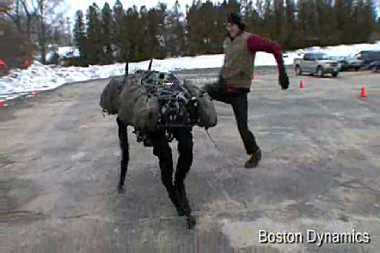
Three UGVs that have gained a great deal of public attention recently are Cheetah, Big Dog, and Petman. All three are manufactured by Boston Dynamics, recently acquired by Google.
This video demonstrates the acceleration capabilities of Cheetah, a robotic quadraped that can reach up to 28.3 mph.
Big Dog is an incredibly steady quadrapedal UGV. It is unique in that it walks on four legs and has an amazing sense of balance. It weighs 240 lbs, is 2.5 feet tall, and 3 feet long. It can move at 4mph, and carry 340 lbs.
This video demonstrates Boston Dynamic's progress in manufacturing human-like unmanned devices. Nicknamed "Petman", it demonstrates the potential for humanoid robots in the very near future.
The nature of UGVs is rapidly changing, and future posts will illuminate the ways in which these systems can manage without human assistance as well as enable human controllers in a variety of situations.
Unmanned Aerial Vehicles
Unmanned aerial vehicles are what are most commonly referred to as 'drones.' A UAV is any flying device which operates without a human pilot in the cockpit of the device. Thus, even the commercially available flying toys could be technically counted as UAVs. UAVs, like UGVs, vary tremendously in size and can be divided into 'planes', 'helicopters', and 'blimps.'
The Northrop-Grumman MQ-8 Fire Scout UAV helicopter has been utilized by the US Navy since 2002. It weighs about one ton, is 24 feet long, has infrared optics, and can carry almost a thousand pounds of payload.
This unmanned airship, the 71M Aerostat Test Balloon, took off in 1996 and was able to track aircraft and cruise missile up to 150 nautical miles away. Since then, China, Israel, and many other nations have developed their own 'spy blimps'. The US is currently manufacturing a blimp that can lift over 500 tons of payload in conjunction with Northrop-Grumman.
Quadcopters have most recently been in the news because of Jeff Bezos's claim that Amazon Prime would begin delivering via quadcopter in the near future. Other companies, such as Dominos, have also suggested the use of quadcopter for fast delivery. Quadcopters can be purchased online or built with hobby kits for only a few hundred dollars, and have GPS navigation capabilities. They can be flown via smartphones, tablets, computers, and a variety of handheld controllers. These devices will be explored in much greater detail in the following posts.
Many contracting companies have taken to exploring handheld planes that can be operated in the field by military and police personnel. These devices come in a few separated pieces, are put together and then thrown when the motors are operational. They can then be flown via smartphone, tablet, computer, or alternate controller.
Both unmanned surface vehicles (USVs) and unmanned underwater vehicles (UUVs) are aquatic 'drones', the main difference being that unmanned surface vehicles are boats and UUVs are submarines.
An example of a USV, called the "Stingray" by its creators at Elbit Systems. It has a top speed of 40 knots and an endurance (ability to be away from charge station) of eight hours.
Beyond Land, Sea, and Air
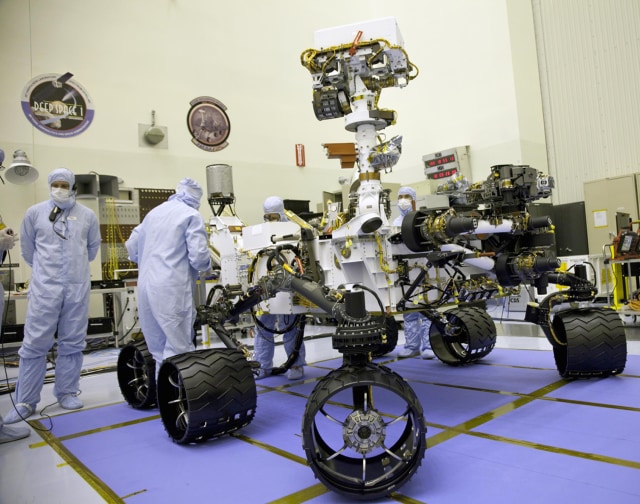
The most commonly known drone outside of the land, sea, and air categories are space exploration devices. These 'rovers' are in the same family as our 'Earth' drones, but operate at vast distances (i.e. other planets!) and in incredibly harsh conditions. Due to the rarity of their production, the cost of their deployment, and the scientific importance of their exploration, they are far more sophisticated than common drones. They can conduct scientific observations of climate and soil samples, relaying that information from Mars back to Earth. Many of their functions are completely autonomous, while others are sent from NASA into space, sometimes with a delay of over 30 minutes.
Another area of unmanned technologies, known as nanorobotics, focuses solely on the miniaturization of robots. Scientists have already designed prototype aerial robots as small as flies, and nanorobots that can flow through the bloodstream. The National Nanotechnology Initiative encourages these developments for medical and scientific purposes.
Mars Rover "Curiosity" is one of several unmanned space exploration vehicles.
Nano quadrotors were developed at University of Pennsylvania and demonstrate the potential for miniaturization of drones in general.
Nanomedicine is a rapidly evolving field in which microscopic robots are programmed to autonomously deliver medicine and conduct medical procedures within the human body.